Best Neighborhoods in Miami to Buy a House — How to Find Your Best Fit
This guide expands on Javier's Miami buying advisory.
The Short Answer — "Best" Means Best Fit
Miami-Dade County contains dozens of distinct municipalities and neighborhoods, and no ranking can tell you which one is right for your purchase. The useful question is not "what is the best neighborhood" but "what is the best fit for my criteria." This guide gives you the framework to answer that: build your criteria, understand the geography, compare areas neutrally, and research locations yourself using primary sources.
Build Your Buyer Criteria First
Before comparing any two areas, write down what actually matters to you. A serious criteria list usually includes:
- Property type and lot — the size, style and outdoor space you want, and the housing stock that delivers it.
- Commute and routine — where you actually go weekly, and what getting there looks like at real hours.
- Walkability vs driving — whether daily errands on foot matter to you or not.
- Water, flood and insurance due diligence — address-level exposure and cost, not area assumptions.
- Association rules — your tolerance for architectural review, restrictions and fees where communities have them.
- Renovation appetite — turnkey versus a property you intend to change, and local rules that affect that.
- Architectural preference — Miami's areas differ enormously in housing character and era.
- Access to services, parks and transit — the specific ones you will use, not generic amenity lists.
- Budget and ownership cost — the full cost of owning in each area, not just purchase price.
Two factors deserve a deliberate approach. If schools matter to you, verify assignments and official performance information directly from the school district and state public sources for the specific address, and make your own decision. If safety matters to you, consult official law-enforcement and public-data sources and visit areas yourself. Neither is something this page — or any ranking — should decide for you.
Miami Geography — Municipalities, Not One City
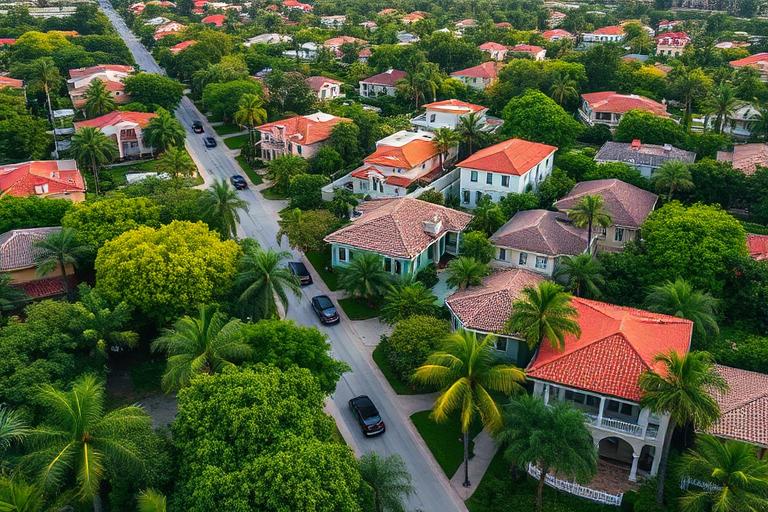
"Miami" in a property search rarely means only the City of Miami. Coral Gables, Miami Beach, Pinecrest, South Miami, Key Biscayne and others are separate municipalities with their own governments, zoning and services, and large residential areas are unincorporated Miami-Dade County. The same street name can cross jurisdictions with different rules. When you shortlist an address, confirm which jurisdiction it sits in — that determines permitting, local rules and services.
Neutral Area Examples for House Buyers
The examples below describe what kind of housing context each area offers — they are not rankings, and no order is implied. Match them against your criteria list.
Coral Gables
A separate municipality with varied single-family housing stock across its sections, distinctive Mediterranean Revival and later architecture, and meaningful street-to-street differences in lot size, tree canopy and proximity to its downtown. Buyers comparing it should look section by section rather than treating it as one market. A dedicated area guide is in the Coral Gables homes and condos guide.
Coconut Grove
A City of Miami neighborhood mixing older and newer homes under a dense tree canopy, with a walkable village core and a waterfront context along Biscayne Bay. Housing character, lot patterns and elevation vary within the neighborhood, so address-level diligence matters. More detail is in the Coconut Grove real estate guide.
Pinecrest
An incorporated village south of Coral Gables that is predominantly single-family and lot-oriented, with a suburban pattern of larger lots and its own municipal services and code enforcement. It suits buyers whose criteria prioritize lot size and a suburban format; as everywhere, verify the specific address against your own criteria.
South Miami, High Pines and Ponce-Davis
South Miami is a small incorporated city with a walkable downtown district; High Pines and Ponce-Davis are nearby residential areas with their own characters and, in places, different jurisdictions. These distinctions matter — municipality versus unincorporated area affects rules and services — so confirm jurisdiction when an area straddles boundaries.
Miami Beach Islands and Residential Pockets
Miami Beach is a separate municipality, and beyond its condominium districts it includes island and residential pockets with single-family homes, many with waterfront exposure. Waterfront and island ownership carries specific diligence — flood exposure, seawalls, insurance, bridge access — that should be evaluated address by address. Area context is in the Miami Beach condos and homes guide.
Kendall, Palmetto Bay and Cutler Bay
Southern Miami-Dade offers different suburban housing contexts: Kendall is a large unincorporated area, while Palmetto Bay and Cutler Bay are incorporated municipalities. Housing stock, lot patterns and commute profiles differ from the closer-in areas, and whether that trade-off fits depends on your routine and criteria.
Brickell and Downtown — Know What You Are Shopping
Brickell and Downtown Miami are primarily condominium and urban markets; dedicated house inventory is limited. Buyers who require a house but want proximity to the urban core usually broaden the search to nearby single-family areas rather than expecting house inventory in the high-rise districts themselves.
A Comparison Matrix Built From Your Criteria
Instead of scores or ranks, build a simple matrix: your criteria down the side, your shortlisted areas across the top. For each cell, record what you verified — housing stock that fits, the real commute at real hours, flood-zone and insurance findings for specific addresses, association rules where they exist, and how the area felt when you visited. The area with the most cells matching your criteria is your best fit; no published ranking can compute that for you.
How to Research a Location Yourself
- Visit and drive each candidate area at the times you would actually be there — weekday mornings, evenings, weekends.
- Verify flood-zone designations for specific addresses through official mapping resources.
- Check public records for the jurisdiction, zoning and any property history relevant to you.
- Review municipal rules — permitting, short-term rental or renovation restrictions — for the actual jurisdiction.
- Test the commute and routine trips yourself rather than relying on estimates.
- Where schools or safety matter to you personally, use the school district, state education resources and official law-enforcement public data — and decide for yourself.
Comparing Properties After the Area Shortlist
Once the shortlist is set, the comparison shifts from areas to specific properties: condition and renovation scope, lot and orientation, address-level flood and insurance information, association obligations where applicable, and how each home competes against the live inventory a buyer would cross-shop it with in Miami listings.
Next Steps
Explore area and lifestyle context in Miami communities, compare live inventory in Miami listings, and for representation through the search and purchase, see buying services. If you are still deciding between property types, read Miami condo vs single-family.