Most Expensive Condos in Miami: Penthouses, Trophy Residences & What Drives Value
This guide expands on Javier's Miami luxury real estate guide.
What Are the Most Expensive Condos in Miami?
Any specific answer goes stale quickly: trophy residences trade privately and infrequently, and the record-setters change as sales close. The durable answer is a category, not a list — penthouses, full-floor residences and rare water-facing units in a small set of buildings where location, building quality and residence-specific factors align. Understanding those factors matters more than memorizing a "top ten," and current listings will always tell you what is actually available today.
What Makes a Miami Condo Ultra-Luxury?
There is no universal price threshold where "luxury" becomes "ultra-luxury." At the top of the condo market, value is created by a combination of factors — and the absence of even one can separate a genuine trophy residence from a merely expensive one. Javier evaluates candidate residences against the framework below before discussing price at all.
Location
Irreplaceable positioning — oceanfront, private island, protected bayfront.
Building quality
Architecture, construction standard, and how the building has been maintained.
The exact residence
Line, layout and scale within the building — not just the address.
Floor, view & exposure
The specific view corridor and light, evaluated from the living areas.
Privacy
Private elevators and foyers, few residences per floor, discreet access.
Terraces & outdoor space
Usable private outdoor living — a defining trait of Miami trophy units.
Services & amenities
Staffing depth and service culture, not amenity-list length.
Parking & storage
Deeded spaces, private garages and storage where applicable.
Scarcity
How rarely comparable residences reach the market at all.
Condition & vintage
Turn-key new construction versus a resale that may need renovation.
Association health
Budget, reserves, insurance and governance of the condominium.
One distinction worth settling early: this framework is specific to vertical living. Buyers weighing a trophy condo against a gated waterfront estate are making a different decision — dockage, land and privacy trade against services, security and lock-and-leave convenience — and Javier's comparison of Miami luxury condos versus waterfront mansions walks through that choice directly.

Where Miami's Most Expensive Condos Are Concentrated
The upper end of the condo market is geographically concentrated, but no single area "wins" outright — each competes at the top for a different reason, and the right one depends on how a buyer wants to live. What follows is a map of the territory, not a ranking.
Fisher Island
A private island reachable only by ferry or boat, Fisher Island pairs controlled access with a strictly limited supply of residences. That combination of controlled access and limited supply supports ultra-luxury condo values and unusually thin inventory turnover. Buyers here are purchasing membership in a self-contained community as much as a residence.
Miami Beach
Oceanfront Miami Beach holds the broadest concentration of trophy condo product. The South of Fifth district at the island's tip combines boutique towers with walkable dining and open water views in three directions; Mid-Beach contributes a newer generation of design-led oceanfront buildings — Faena House among them. Direct beach frontage remains the constant: land on the sand cannot be reproduced, and buildings that own it hold a structural advantage.
Surfside & Bal Harbour
North of Miami Beach, the Surfside–Bal Harbour corridor trades urban energy for quiet, low-density oceanfront exclusivity. Boutique buildings with very few residences — Arte by Antonio Citterio in Surfside is a well-known example, with only sixteen units — and hotel-branded properties such as the Four Seasons Residences at The Surf Club and the St. Regis Bal Harbour define the corridor's character: small scale, deep service and extreme scarcity.
Brickell
Brickell's contribution to the top of the market is the urban penthouse: full-floor and upper-tier residences with skyline and Biscayne Bay panoramas above Miami's financial district. The buyer profile skews toward those who want walkable city living with water views rather than sand — and the bayfront towers along Brickell Avenue's eastern edge supply the corridor's most valuable residences.
Coconut Grove
The Grove competes through restraint: low-density bayfront buildings set among mature tree canopy, with a village atmosphere that most high-rise corridors cannot offer. Its newest generation of design-driven buildings around the Park Grove area brought genuinely large residences to a neighborhood where zoning keeps supply structurally limited — a formula that keeps Grove penthouses genuinely scarce whenever they reach the market.
Emerging bayfront corridors — Edgewater among them — occasionally produce standout penthouses, but the deepest and most consistent concentration of ultra-luxury condo value remains in the five areas above.
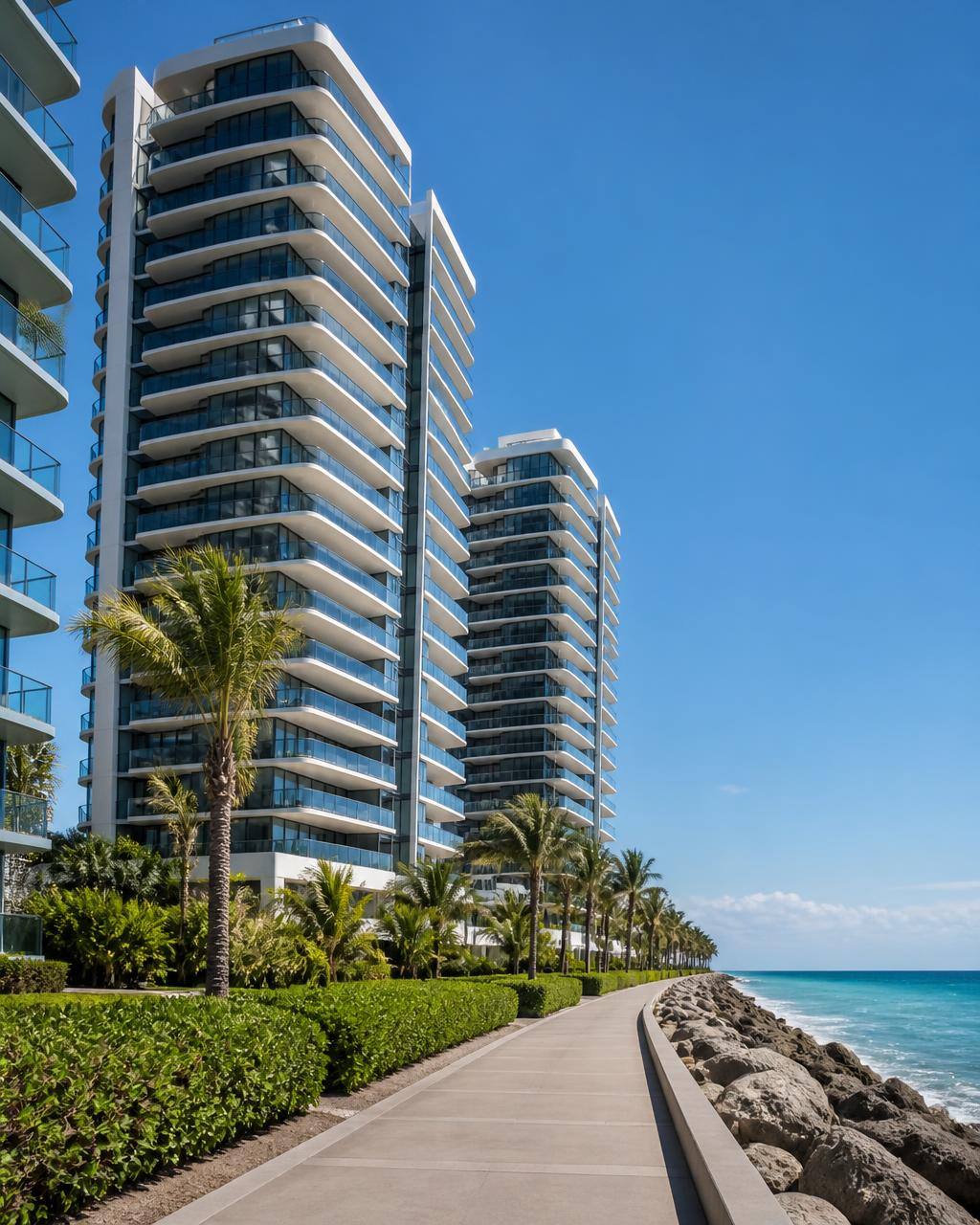
Why the Exact Residence Matters as Much as the Building
The building sets the context — address, architecture, services, financial health — but the specific residence frequently creates the value difference. Within a single tower, two units of similar size can occupy entirely different tiers of the market depending on line, floor, exposure and outdoor space. The "01 line" facing open water does not trade like an interior line facing another tower, even on the same floor with the same finishes.
The residence-level variables that move value most: the floor and its specific sightlines; the layout and whether principal rooms face the primary view; terrace depth and usability; corner exposures and natural light through the day; privacy of arrival (private elevator foyers versus shared corridors); deeded parking and storage; current condition; and — above all — scarcity of that particular combination. A renovated lower-floor residence with a rare 2,000-square-foot wraparound terrace can out-trade a higher, larger unit with a standard balcony.
Buyers shop buildings; owners sell residences. The discipline at this level is evaluating the exact unit — not the brochure.
Penthouses and Trophy Residences — Market Terms, Not Legal Categories
Neither "penthouse" nor "trophy residence" is a regulated classification. Developers routinely label multiple upper floors "penthouse levels," and a unit marketed as a penthouse may share its floor with several others. What the market actually rewards is the substance behind the label: top-of-building position, meaningfully larger scale than the tower's typical residence, private outdoor space, and elements that cannot be replicated below — double-height ceilings, rooftop terraces, private pools.
"Trophy residence" is broader: any residence rare enough to have no ready substitute. That can be a penthouse, but it can also be a full-floor residence mid-tower, a lanai unit with direct beach access, or a corner line with a protected panoramic view. When evaluating a residence marketed with either label, the useful question is never "what is it called?" but "what exactly makes this one irreplaceable — and would the next buyer agree?"
Views, Elevation and Future Sightlines
Water views drive Miami condo value more than any other single amenity, but they need to be evaluated precisely. Direct frontal views trade differently from angled or partial ones; a view enjoyed from the living room and primary suite is worth more than the same view visible only from a guest bedroom. Light and orientation matter too — eastern exposures take sunrise over the ocean, western exposures take sunset over the bay and skyline, and double exposures capture both.
Higher is not automatically better. Above a certain elevation the experiential gain per floor flattens, while some buyers actively prefer lower residences that feel connected to the water or gardens. The more important question is durability: is the view protected — over the ocean, a park, a bay, or a height-capped district — or does it cross a parcel that could support future construction? A sightline that can be built out is a risk to underwrite, and reviewing surrounding zoning and announced projects is a standard part of the evaluation Javier runs before a client commits to a view-driven premium.
Privacy, Services and Branded Residences
At the top of the market, privacy and service are product features, not luxuries. Private elevator entries, a small number of residences per floor, discreet parking arrangements and staff who manage day-to-day logistics are part of what separates the top tier from the merely high-end. Service depth is worth probing beyond the amenity list: staffing ratios, concierge scope, in-residence dining or housekeeping availability, and how well the building actually delivers what it advertises.
Branded residences — buildings developed with a luxury hospitality, fashion or automotive marque — are a significant presence in Miami's upper tier, from hotel-branded properties like the Four Seasons Residences at The Surf Club to standalone projects such as the Aston Martin Residences on the Downtown waterfront. The brand itself is not the asset; what buyers are paying for is the service standard, design discipline and recognition the brand enforces — attributes that matter to some buyers and can shape a building's perceived appeal, though neither the brand nor the logo guarantees resale liquidity, appreciation or value retention. The evaluation framework stays the same: the specific residence, the building's quality and the association's health matter more than the logo in the lobby.
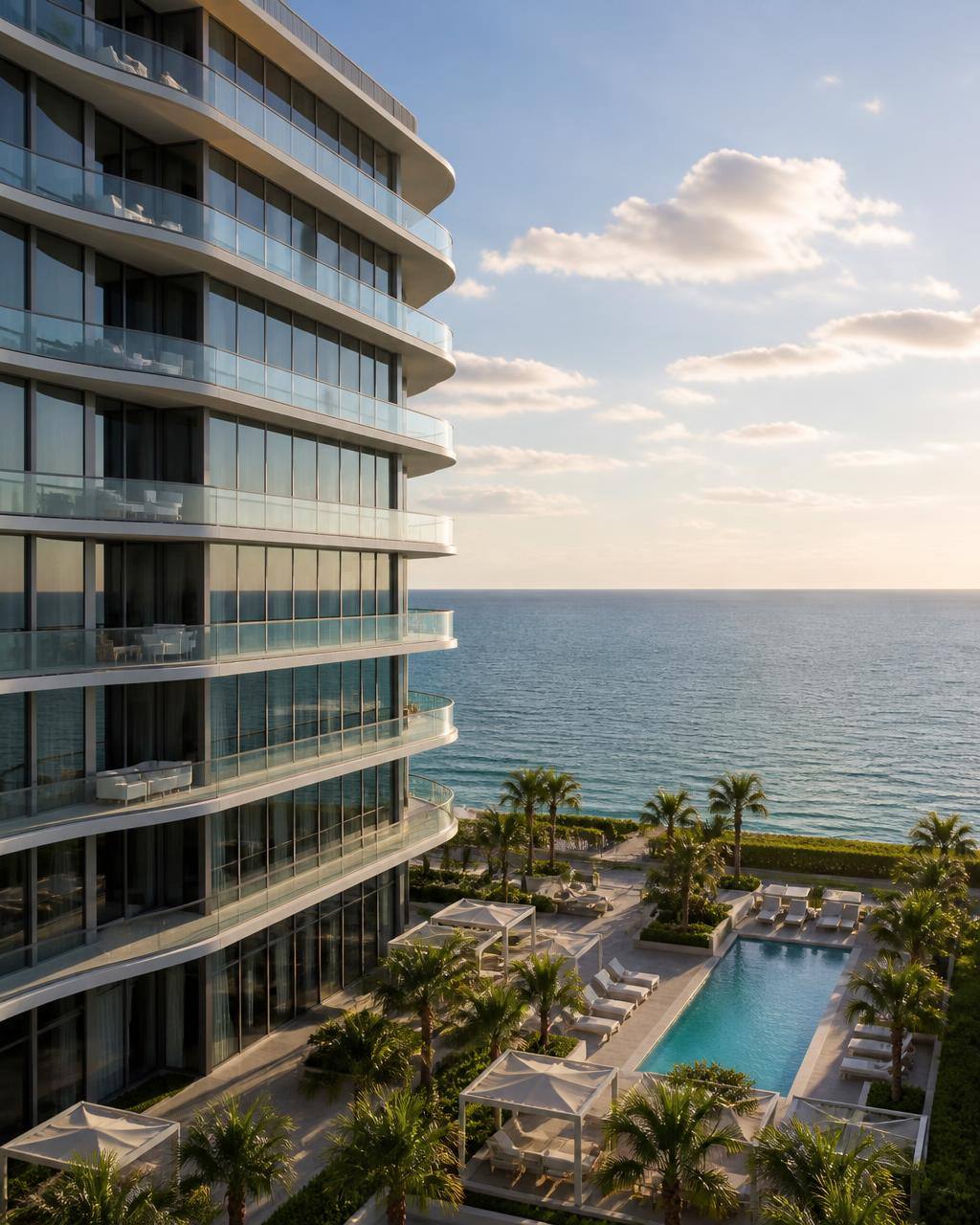
How Ultra-Luxury Condos Are Valued
Price per square foot is the most quoted metric in this segment — and the most misused. It works as context when the comparable pool is deep and the residences are genuinely similar. At the trophy level, neither is true: sales are infrequent, terraces and private outdoor space are inconsistently counted, and the factors that actually drove a record sale — a protected view, a rare line, provenance, condition — are invisible in a per-foot figure. Two legitimate sales in the same building can sit far apart on that metric without either being mispriced.
Serious valuation at this level is closer to appraisal craft than arithmetic: recent closed sales in the building and its true peer set, adjusted for line, floor, view, outdoor space and condition; current competing inventory; and the depth of the buyer pool for that specific product. Recorded sales are public through the Miami-Dade County Property Appraiser, which makes verification straightforward — and broader conditions worth weighing sit in Javier's Miami real estate market analysis. What no buyer should rely on is a static published number: at this altitude, valuation is residence-specific and current, or it is wrong.
New Construction vs. Established Luxury Buildings
The top of the market splits between two kinds of product. New and pre-construction buildings offer current design standards, full warranty periods, and — at the trophy level — the chance to combine or customize residences before delivery; the trade-offs are completion-timeline risk and less certainty about how the building will actually operate once residents move in. Established buildings offer the opposite bargain: a known service culture, a visible association track record and immediate occupancy, sometimes at the cost of dated interiors that need renovation — a meaningful undertaking under condominium rules.
Neither is categorically better; the decision is about risk tolerance and timeline. Buyers leaning toward new product should read Javier's guide to buying new construction in Miami for the process itself, and can survey active projects on the new developments page.
Due Diligence Before Buying at the Top of the Market
The larger the purchase, the more the condominium behind the residence matters. Building-level review starts with the association's financial condition: the operating budget, how reserves are funded, recent and pending special assessments, and the building's insurance program. Florida law also imposes two distinct condo-safety requirements that a buyer's team should review separately where applicable: the milestone structural inspection under Section 553.899, Florida Statutes — a structural inspection that generally applies to condominium and cooperative buildings three habitable stories or more, on age-based cycles set by the statute — and the Structural Integrity Reserve Study (SIRS) under Section 718.112(2)(g), Florida Statutes, a reserve and structural-integrity planning study for condominium buildings three stories or higher subject to that statute. The two interact — current law allows certain associations to complete a SIRS alongside a required milestone inspection, and a qualifying recent milestone inspection may in some cases satisfy the visual-inspection portion of a SIRS — but they are separate requirements, and a buyer's team should read the milestone inspection report and the most recent SIRS where each applies, not merely confirm they exist; the buyer's counsel should confirm which requirements apply to the specific building. Governing documents complete the picture — rental minimums, renovation rules, pet and guest policies, and approval processes all shape how the residence can actually be used and resold.
Residence-level review is equally specific: physical condition and any past water intrusion; exactly which parking spaces and storage units convey and how they are titled; terrace ownership and maintenance responsibility; and how the asking price sits against recent closed sales and the current competing inventory. None of this replaces advice from the buyer's own attorney and tax professionals — at this level, a coordinated team is standard practice. The transaction mechanics are covered step by step in Javier's guide on how to buy a condo in Miami, and buyers who want a senior broker running the evaluation and negotiation directly can start with his private buyer representation.
At the trophy level, the association's balance sheet is part of the residence. Javier reads the budget before he discusses the view.
How to See What Is Currently on the Market
Ultra-luxury inventory moves continuously, and a meaningful share of it never appears publicly — trophy residences are often shown privately before, or instead of, being listed. The practical approach is to monitor the visible market through a live search of current Miami listings, orient within the broader segment through the Miami luxury real estate overview, and then work building-by-building with a broker who tracks availability building by building in the specific towers that fit the brief. That is how the top of this market actually transacts — quietly, residence by residence.